

Professional Bookkeeping
Company in London

Why Every London Business Needs a Professional Bookkeeping Company
Running a business in London is exciting, competitive, and demanding. Between managing clients, growing your team, and keeping up with tax and compliance duties, financial records can easily fall behind. That is where a professional bookkeeping company in London becomes indispensable.
At ENCY&LINE, we work with sole traders, SMEs, landlords, contractors, and limited companies across London and the surrounding area to keep books accurate, up to date, and fully compliant with HMRC and Companies House requirements. Reliable bookkeeping is not just admin; it is the foundation for clean accounts, tax accuracy, cash-flow control, and confident business decisions.

What Is Bookkeeping and Why Does It Matter?
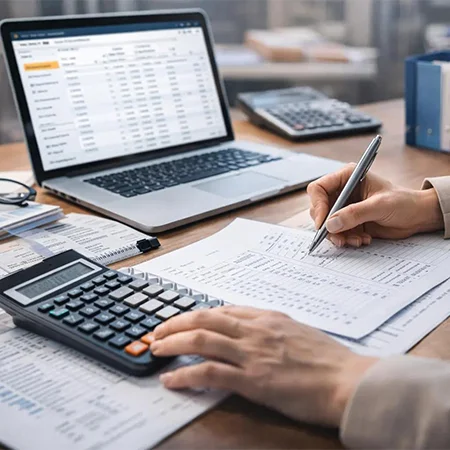
Bookkeeping is the systematic recording of your business's financial transactions: every sale made, every expense incurred, and every invoice raised or paid. It is the day-to-day process that keeps your accounts accurate and gives HMRC, Companies House, and your own management team a reliable view of the business.
For many business owners, bookkeeping feels like a burden. But neglecting it, or doing it poorly, creates problems that are far more costly than the time needed to get it right. Late filings, incorrect tax returns, penalty charges, and cash-flow surprises are all common consequences of poor records. Done well, bookkeeping gives you a real-time view of financial health and helps ensure deadlines are not missed.
What Does UK Law Require?
HMRC and Companies House both impose clear record-keeping obligations on UK businesses. The exact requirements depend on whether you trade as a sole trader, partnership, landlord, or limited company, but every business needs records that are complete, accurate, and available if HMRC asks questions.
| Business type | Core bookkeeping requirement |
|---|---|
| Sole traders and partnerships | Keep records of business income and expenses for Self Assessment and choose the correct accounting method. |
| Limited companies | Prepare statutory annual accounts, calculate Corporation Tax, and file a Company Tax Return. |
| VAT-registered businesses | Maintain digital VAT records and submit VAT returns accurately under Making Tax Digital rules. |
| Employers | Keep payroll records and ensure PAYE, National Insurance, pensions, and RTI submissions are correct. |
For Sole Traders and Partnerships
If you are self-employed as a sole trader or in a partnership, GOV.UK says you must keep records of your business income and expenses for your Self Assessment tax return. From the 2024 to 2025 tax year, cash basis is the default accounting method for many self-employed people, meaning income and expenses are recorded when money is received or paid, unless you opt out or cannot use it.
For Limited Companies
Limited companies face more detailed obligations. After the end of each financial year, a private limited company must prepare statutory annual accounts and a Company Tax Return. Clean bookkeeping throughout the year makes these filings faster, more accurate, and less stressful.
| Requirement | Usual deadline |
|---|---|
| File annual accounts with Companies House | 9 months after the company financial year ends. |
| Pay Corporation Tax or tell HMRC nothing is due | 9 months and 1 day after the accounting period ends. |
| File the Company Tax Return with HMRC | 12 months after the accounting period ends. |
Record Retention Matters
Bookkeeping is not only about recording transactions today. It is also about keeping evidence safely. Companies generally need to retain financial records for at least six years from the end of the relevant accounting period. Sole traders and partnerships must usually keep records for five years after the Self Assessment filing deadline for the relevant tax year. A good bookkeeping company helps ensure records are organised, backed up, and retrievable if HMRC opens an enquiry.
What a Good Bookkeeping Company in London Does for You
Many business owners associate bookkeeping with data entry alone. In reality, a competent bookkeeping service covers far more ground. It turns everyday financial activity into reliable records that support tax returns, VAT submissions, payroll, accounts, and management decisions.
Core bookkeeping support
- Transaction recording and categorisation so every sale, purchase, expense, and bank transaction is posted correctly.
- Bank reconciliation to match bank statements against accounting records and catch discrepancies early.
- VAT records and MTD compliance for VAT-registered businesses that need accurate digital records and timely VAT returns.
- Payroll record support so employee pay, PAYE liabilities, pension deductions, and RTI submissions line up with the accounts.
- Year-end preparation to make statutory accounts and tax returns easier, faster, and more reliable.
Making Tax Digital: What London Businesses Need to Know
Making Tax Digital is HMRC's programme for moving tax reporting online. MTD for VAT is already part of life for VAT-registered businesses. MTD for Income Tax is being introduced for sole traders and landlords with qualifying income from self-employment and property above £50,000 from 6 April 2026. Those affected need compatible software, digital records, quarterly updates, and a final tax return submission.
If your business is approaching the MTD thresholds, now is the time to get your bookkeeping in order. ENCY&LINE offers MTD support for sole traders, landlords, and business owners who want to move to digital records before the pressure of deadlines arrives.
Common Bookkeeping Mistakes London Businesses Make
Even diligent business owners can fall into habits that cause problems later. These mistakes often look small at the time but can distort accounts, increase tax risk, or create avoidable stress at year end.
| Common mistake | Why it matters |
|---|---|
| Mixing personal and business finances | Makes accurate record-keeping difficult and can invite unnecessary scrutiny. |
| Failing to keep receipts | HMRC may disallow legitimate deductions without supporting evidence. |
| Leaving bookkeeping until year end | Errors compound, reconciliations take longer, and decision-making suffers. |
| Ignoring mileage and use-of-home claims | Valid deductions may go unclaimed, increasing the tax bill unnecessarily. |
| Misclassifying expenses | Distorts accounts and can trigger HMRC questions on a return. |
Why Choose ENCY&LINE as Your Bookkeeping Company in London?
ENCY&LINE is a London-focused accounting and tax firm with a genuine commitment to accuracy, transparency, and long-term client relationships. Our team works across a wide range of industries, including hospitality, construction, property, transport, professional services, and legal services, giving us practical experience of the real-world bookkeeping challenges businesses face.
We are not a one-size-fits-all practice. Every client receives support tailored to their business structure, sector, and growth stage. Because we cover bookkeeping, payroll, VAT, statutory accounts, Corporation Tax, and Self Assessment, your finances are managed as one connected picture rather than a collection of disconnected tasks.
Get Started With a Free Consultation
Looking for a reliable bookkeeping company in London? ENCY&LINE is ready to help. Whether your records need catching up, your business is moving to MTD, or you want regular monthly support, our team can keep your books in order and your compliance under control.
Professional bookkeeping keeps records accurate, supports tax and Companies House filings, improves cash-flow visibility, and reduces the risk of missed deadlines, penalties, and unreliable year-end accounts.
A sole trader must keep records of business income and expenses for Self Assessment, along with personal income records and evidence for figures reported to HMRC.
Annual accounts are usually due 9 months after the company financial year ends, Corporation Tax is usually due 9 months and 1 day after the accounting period ends, and the Company Tax Return is due 12 months after the accounting period ends.
Making Tax Digital for Income Tax is HMRC's digital reporting system for sole traders and landlords. From 6 April 2026, it applies to those with qualifying self-employment and property income above £50,000.
Most active businesses should update bookkeeping at least monthly. VAT-registered businesses, employers, and fast-growing companies often benefit from more frequent reconciliations and reports.
Related post



Keep your books accurate, compliant, and ready for every deadline